MELFA Robot
About the plugin
The MELFA Robot plugin allows you to connect to a Mitsubishi Electric Factory Automation (MELFA) robot controller during simulation and exchange data. For example, a program running in a virtual or physical MELFA controller can drive the joints of a MELFA robot in a simulation, read data from sensors and set outputs for picking and placing products.
The plugin is associated with the Connectivity feature of Visual Components Premium and can connect to one or more MELFA robot controllers. The simplified workflow is the following:
- Add server
- Connect to the server
- Map variables
- Run the simulation
Terminology
- MELFA – Mitsubishi Electric Factory Automation is the manufacturer and distributor of industrial robots.
- RT ToolBox3 – Offline programming software and simulator for MELFA robots.
- PC side I/F – I/F refers to the interface for the connection or type of connection.
- I/O (Input/Output).
Read and Write Support
Read and Write table
| Type | Read | Write | Notes |
| Robot controller digital inputs and outputs |
Yes |
Yes | Signals |
| Current joint values from any robot of the connected controller |
Yes |
No |
Requirements
The connection requires Visual Components Premium.
Note: RT Toolbox3 is not a requirement for the connector, only if a connection to a virtual controller is required.
Setup
- Check that your host PC meets the requirements.
- Access the MELFA robot controller.
- The plugin connects to the robot controller, so the virtual or physical robot controller should be accessible via a direct network connection (IP address).
- For a simple setup with a localhost connection, it is enough to have the simulator running in RT ToolBox3.
- In Visual Components, add a new server with the plugin and connect to the controller.
- If you are using RT ToolBox3, in Edit Connection set PC side I/F to RT ToolBox3. This will trigger a test that verifies if a connection is possible.
- If a connection is possible, the Robot on the server side property under Communication settings will list robots associated with the MELFA controller. The robot you select there can be paired with MELFA robot in your Visual Components layout.
- When you click Apply, the joint values of those robots will be mapped to one another automatically and listed under the Connected Variables panel. As a result, you do not need to map those values yourself.
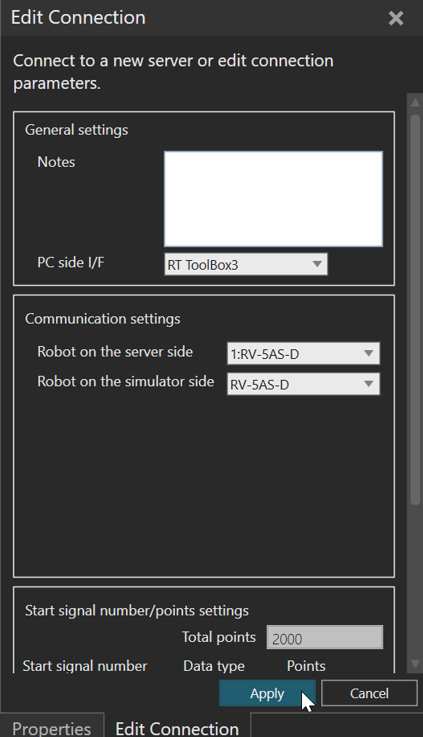
- If connection is not possible, you will receive a notification on how to troubleshoot the connection, e.g. verify the simulator in RT ToolBox3 is running.
- If you are using a real controller, set PC side I/F to Ethernet board and then adjust the Communication settings for your project. For example, you can connect to the main controller or one of its specific CPUs.
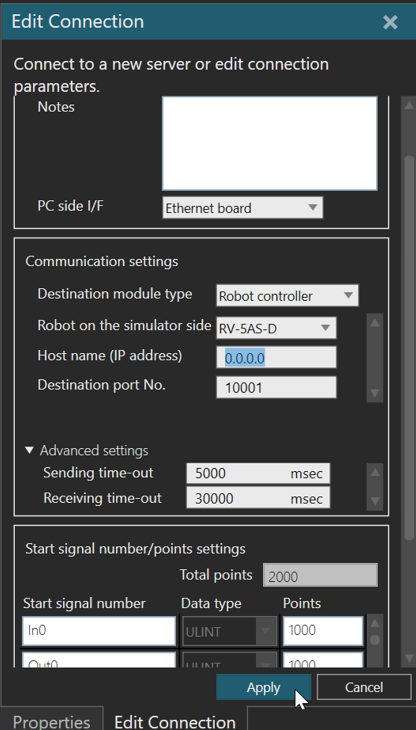
- If you are using RT ToolBox3, in Edit Connection set PC side I/F to RT ToolBox3. This will trigger a test that verifies if a connection is possible.
-
- If you need to work with signals, first disconnect from the controller.
- Then in the Edit Connection panel, create the signal groups you want to work with on the controller and then pair variables to them.
- These signal groups are the input and output signals of the controller you need for your Visual Components simulation.
- Each row defines a range of signals. As an example, In0 with 8 as the point count corresponds to inputs 0-7 on the controller.
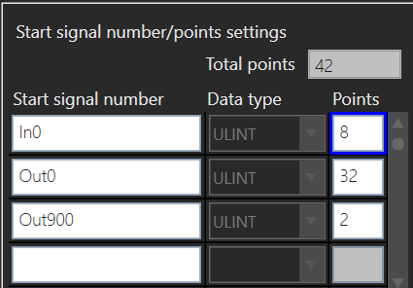
- This group then appears in the Create Variable Pairs editor when you are connected to the controller. Then pair the signals as needed for your project.
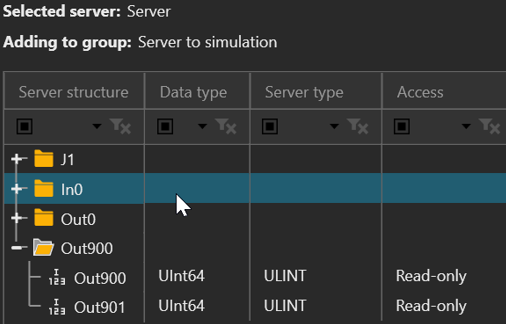
- Map the variables.
- If you need to read a joint value from the controller, map the VALUE property of each degree of freedom (DOF)/Joint of the robot component to the corresponding mechanical unit in the controller. This way the controller drives the robot in the 3D world. Remember that this can be done automatically for you in certain workflows, for example when connecting to RT ToolBox3.
- For simulating actions such as grasp/release, map the outputs of the robot component for those actions to the I/O of the controller you will use for those actions.
- Run the simulation.
- Simulate to start the exchange of data. Note that in the Connected Variables panel, the Prepared value column can be used to set values for testing.
Capabilities
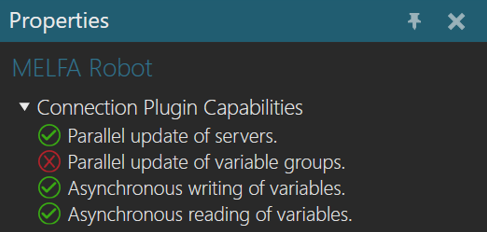
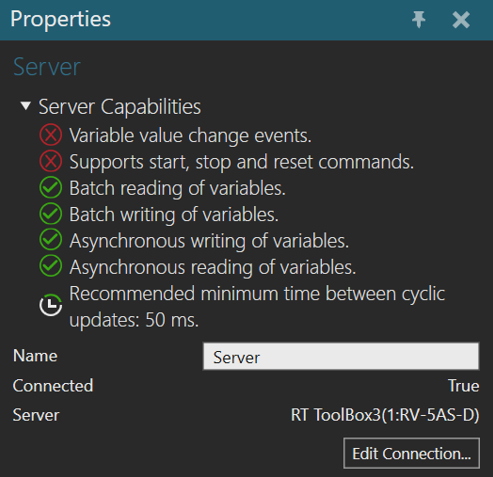
You can verify the capabilities of the MELFA Robot plugin and subsequent server connections in the Properties panel.
Plugin
- In the Connectivity Configuration panel, select MELFA Robot.
- In the Properties panel, expand Connection Plugin Capabilities.
Server
- In the Connectivity Configuration panel, expand MELFA Robot, and then select an active server connection.
- In the Properties panel, expand Server Capabilities.
Connection Settings
A MELFA Robot plugin connection requires a MELFA robot controller to have an IP address. Each connection in Visual Components is a client to the controller and is not meant to remotely operate the robot.
Error handling
- If the connection to the controller is lost, the exchange of data will stop. In such cases the plugin expects an event to be received from the controller. If the event is not received, you might need to manually disconnect Visual Components from the controller and then attempt to reconnect to verify that the connection is lost.
- Be aware of how signals are used in your MELFA project when attempting to write those signals during simulation. Certain signals might be used by the controller and are read-only.
Limitations
Joint values cannot be written to the robot controller per safety reasons.
Compatibility
The MELFA Robot plugin was developed using RT ToolBox3 and supports a connection to any MELFA robot that is compatible with that technology such as a CR800 series controller.
Supported data types
The MELFA Robot plugin supports access to digital signals, mechanical units joint data and global variables.
| MELFA Robot Type | .NET Type | or | VC PROPERTY TYPE |
| DigitalInput | System.Boolean | VC_BOOLEAN | |
| DigitalOutput | System.Boolean | VC_BOOLEAN | |
| Joint | System.Double | VC_REAL |
Post Processing the Robot Program
Postprocessor
If you need to translate robot programs from your Visual Components model to the native controller, you can use the Postprocessor.
Note: The Postprocessor is available in the following products:
- Visual Components Premium
- Visual Components Premium OLP
- Visual Components Professional OLP
- Visual Components Robotics OLP
For more information on postprocessing using a Visual Components OLP product, see Translate robot program.
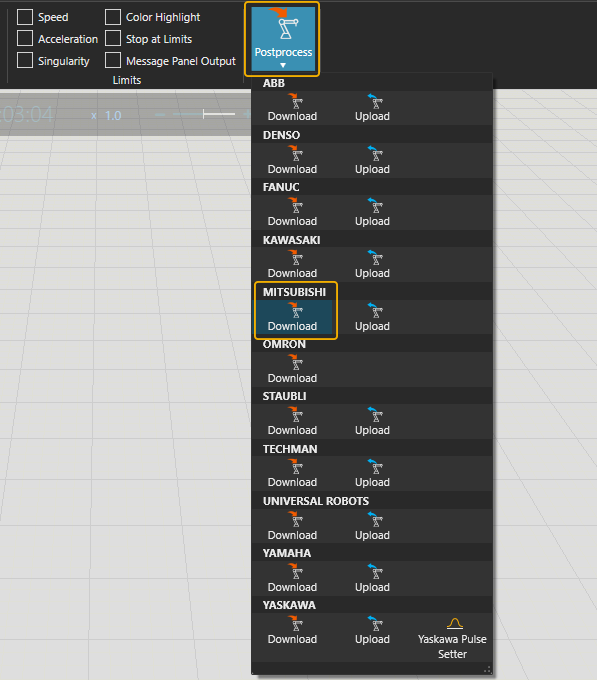
To translate the robot program for the real robot controller:
- Click the robot (or another device) which program you want to translate.
- Click Postprocess from PROGRAM ribbon tools.
- Click Download under the correct robot brand name.
- Browse the folder where you want to save the program file and give name for the file.
-
Click Save.
The file can be transferred to the robot controller
Note: In real robots, run only the robot programs that are translated from calibrated models. Otherwise, there can be unpredictable collisions and errors when executing the program.
For more information check the Visual Components Robotics OLP robot brand specific manuals on the Visual Components OLP Extranet.